
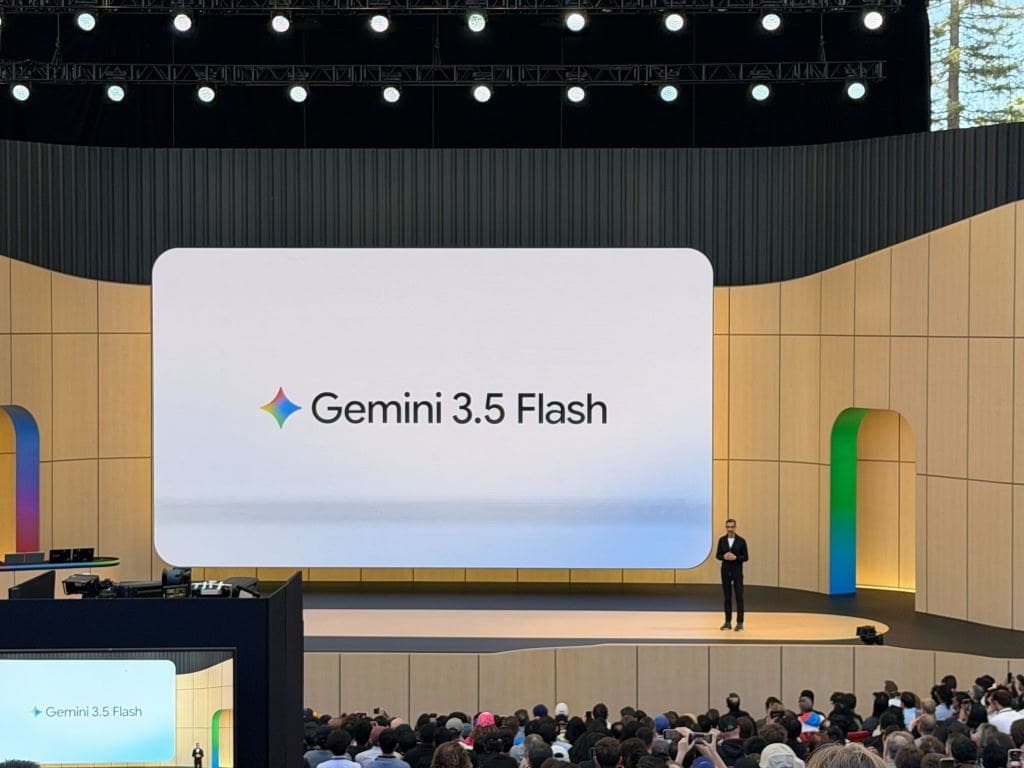
You thought "fast" and "smart" couldn't coexist in a single model. Google I/O 2026, May 19: Koray Kavukcuoglu takes the stage, and Gemini 3.5 Flash arrives. Fourteen days after OpenAI's GPT-5.5 Instant, Mountain View's answer clocks 289 tokens per second, a one-million-token context window, and a price three times lower than its direct competitor. The "fast and cheap" segment just moved to a new address.
Short version
What Google shipped on May 19
When Koray Kavukcuoglu, DeepMind's Chief Technologist, announces Gemini 3.5 Flash, he isn't selling a replacement model. He's selling a repositioning. The core message, echoed in the official Google blog:
“Gemini 3.5 Flash delivers intelligence that rivals large flagship models on multiple dimensions at speeds you have come to expect from the Flash series. It's our strongest agentic and coding model yet, outperforming Gemini 3.1 Pro on key benchmarks...often at less than half the cost of comparable models.
”
This is no longer the usual Flash trade-off of "less capable but cheaper." It's a claim that the trade-off no longer exists. The Google DeepMind blog puts it plainly: "You no longer have to trade quality for latency."
For builders evaluating the model, the technical specs:
On the other side, GPT-5.5 Instant set its baseline on May 5: $5.00 / $30.00 per million tokens, a nearly identical context window (1,050,000 tokens), but a max output of 128,000 tokens (roughly 2x Flash) and an August 2025 cutoff (more recent by date, though earlier than Flash's January 2026).
The numbers reshaping the race
The Artificial Analysis chart says it all. Gemini 3.5 Flash runs at 289 tokens per second on output. Gemini 3.1 Pro is at 135. GPT-5.5 in high mode is at 71. Claude Opus 4.7 is at 67. That gap isn't a spec sheet detail, it's a 4x factor that changes the nature of the agentic workflows you can build.
In terms of cost on a real API call, Artificial Analysis calculates a blended cost of $1.31 per million tokens for Gemini 3.5 Flash with active cache (7:2:1 ratio). For GPT-5.5 Instant, the official LLM Stats pricing is $5.00 / $30.00, a 3.3x ratio on input.
| Criterion | Gemini 3.5 Flash | GPT-5.5 Instant |
|---|---|---|
| Input price (1M tokens) | $1.50 | $5.00 |
| Output price (1M tokens) | $9.00 | $30.00 |
| Output speed | ~289 t/s | ~61.5 t/s |
| Input context | 1,048,576 | 1,050,000 |
| Max output | 65,536 | 128,000 |
| Knowledge cutoff | Jan. 2026 | Aug. 2025 |
| GA launch | May 19, 2026 | May 5, 2026 |
On the agentic benchmarks where Google published its own evaluations (MCP Atlas, Toolathlon), Gemini 3.5 Flash scores 83.6% on multi-tool coordination. GPT-5.5 has not published its scores on these reference sets, which makes direct comparison difficult and, precisely, benefits the Google narrative.
Multimodal understanding (reasoning over images, charts, PDFs) is the other clear territory: BenchLM measures 83.8 vs 70.4 in Flash's favor, a +13.4-point margin. For workflows processing structured documents or screenshots, that's a concrete advantage.
But Gemini 3.5 Flash is not the absolute number one
The Artificial Analysis Intelligence Index (v4.0) resets the cursors. GPT-5.5 is number one at 60 points. Claude Opus 4.7 and Gemini 3.1 Pro are at 57. Gemini 3.5 Flash trails in this composite ranking. That's not a failure, it's the deliberate positioning of a Flash model in an ecosystem where speed and cost outweigh composite score.
BenchLM.ai is direct about it: GPT-5.5 Instant sits at 91, Gemini 3.5 Flash at 87 on the global score. The gap is 4 points, "large enough that you do not need to squint at the spreadsheet to see the difference" in their words. On pure reasoning, the GPT-5.5 advantage grows to +10.3 points (85 vs 74.7) and on ARC-AGI-2, it dominates clearly: 84.6% vs 72.1%.
The sharpest number comes from an encyclopedic knowledge benchmark: Humanity's Last Exam caps Flash at 40.2%, below Gemini 3.1 Pro (44.4%). Pushing hard on agents comes at a cost: the model knows less. That's an assumed trade-off, not a surprise.
Pick GPT-5.5 if you want the stronger benchmark profile. Gemini 3.5 Flash only becomes the better choice if multimodal and grounded is the priority or you want the cheaper token bill.
GPT-5.5 Instant has its own weak spot. The Decoder measured an 86% hallucination rate on AA-Omniscience when the model doesn't know the answer (vs 36% for Claude Opus 4.7). OpenAI claims -52.5% hallucinations vs GPT-5.3 Instant, but the paradox is real: the model most accurate on known questions is also the least calibrated on unknowns. For legal, medical, and financial use cases, that calibration gap matters.
The "fast" segment becomes strategic
Tulsee Doshi, senior director at Google, described the target architecture at I/O 2026:
“3.5 Pro becomes your orchestrator, your planner, and then it actually can leverage Flash to be the various sub-agents.
”
That's the pivot most commentary missed. Framing "Flash vs GPT-5.5 Instant" as a single-model choice misses the point. In a modern agentic pipeline, you don't call one model: you have an orchestrator (the most capable, say Gemini 3.5 Pro or GPT-5.5) that dispatches sub-tasks to fast models. Flash isn't competing with GPT-5.5, it's complementing Gemini 3.5 Pro and competing with the fast-tier models from other labs.
In that segment, speed and cost aren't secondary criteria. When an agent calls a model 50 times to validate a pipeline, the 4x speed factor and 3.3x cost factor determine whether a product is viable or too expensive to deploy. That's why Shopify, Macquarie, Salesforce, Ramp, Xero, and AirAsia are cited as pilot adopters before any public announcement.
The comparison with Claude Haiku 4.5 is relevant here: both models compete on the same fast/cheap terrain, but no complete tier-by-tier comparison is public at the time of writing. Available partial benchmarks will favor one or the other depending on the task.
The blind spot: prices are rising everywhere
Simon Willison, an independent developer whose blog is a reference for model evaluations, noted something the press releases don't mention:
“all three of the major AI labs are starting to probe the price tolerance of their API customers
”
The numbers back that diagnosis. Gemini 3.5 Flash at $1.50/$9 costs 3 times its direct predecessor Gemini 3 Flash Preview ($0.50/$3) and 6 times Gemini 3.1 Flash-Lite. GPT-5.5 Instant is 20% more expensive than GPT-5.4 despite a 40% reduction in token consumption (efficiency goes up, pricing does too). The comparison with open-weight models puts the debate in its market context.
Kimi K2.6 from Moonshot AI, released May 6, 2026, illustrates the downward pressure: open-weight, 1.6T MoE with 31B active parameters, 58.6% on SWE-bench Pro, and $0.14 per million input tokens. It's not the same benchmark level as Flash or GPT-5.5, but for simple tasks and raw volume, a 10x cost gap becomes a selection argument.
If your use case is highly volume-sensitive (millions of calls per day), the table above needs to be part of your ROI analysis. Labs are pushing prices upward while open-weight alternatives absorb the pressure from below. That's the structural dynamic of this period, and it won't reverse in a few months.
For builders already on GPT-4o or Gemini 3 Flash, migration isn't neutral: you get a more capable, faster model, but you also pay more per call. The net trade-off depends on your reduction in tokens consumed (fewer corrective calls if the model solves things right first try) versus the higher unit price.
One more limit to know for Gemini 3.5 Flash: no native computer use (GUI control), unlike some competitors. If your agentic workflow involves UI navigation or application manipulation, check the computer use specs before choosing Flash as your base model.
If you're tracking the evolution of Chinese models and the broader lab war, our breakdown of Qwen 3.7 and China's return to the race gives good context for why open-weight models are disrupting Western lab pricing logic.
Frequently asked questions
What's the real price of the Gemini 3.5 Flash API?
$1.50 per million input tokens and $9.00 per million output tokens. With active cache, Artificial Analysis measures a blended cost of $1.31 per million tokens (7:2:1 cache/input/output ratio). For GPT-5.5 Instant, the pricing confirmed by LLM Stats is $5.00/$30.00. The gap is 3.3x on both input and output.
Is Gemini 3.5 Flash really 4x faster than GPT-5.5 Instant?
Per Artificial Analysis measurements available as of May 20, 2026: Gemini 3.5 Flash is measured at roughly 199-289 tokens/s depending on mode (thinking high vs standard). GPT-5.5 Instant is measured at 61.5 t/s in low mode. The ratio is 3 to 4x depending on measurement conditions. OpenAI data on GPT-5.5 high modes is not published, making the comparison partial.
How do I choose between Gemini 3.5 Flash and GPT-5.5 Instant for my agents?
Priority on multimodal (documents, images, PDFs), cost and volume (large-scale production flows), or agentic benchmarks (MCP Atlas, multi-tool coordination): go Flash. Priority on pure reasoning (+10.3 BenchLM points), legal / medical / financial tasks, or large text outputs (up to 128K tokens vs 65K for Flash): go GPT-5.5 Instant. For mixed use cases, both can coexist in the same pipeline (GPT-5.5 orchestrator + Flash sub-agents).
Have Cursor, Perplexity, or Linear switched to Gemini 3.5 Flash or GPT-5.5 Instant?
As of the time of writing (May 21, 2026), no public source confirms a migration by any of these platforms to either model. That's a notable gap in available information. Both models have been in general availability for less than three weeks, so partnership announcements are likely in the coming months but haven't been publicized yet.
Does Gemini 3.5 Flash support computer use (GUI control)?
No. Unlike some competitors, Gemini 3.5 Flash does not have native computer use at launch. That's a limitation to verify if your agentic workflow involves navigating graphical interfaces or manipulating desktop applications. Google's roadmap on this point is not public.
Going further
The official Google video "Gemini 3.5 Flash: Built for AI Agents" published at I/O 2026 gives the best product positioning overview in 5 minutes: agentic demos, Flash + Pro architecture, and the benchmarks Google chose to highlight.
Sources used for this breakdown:
The same fast-model ecosystem is worth following as a whole. The article on Gemini Omni Flash and the previous-generation flash models gives historical context on how Google built the Flash positioning since 2025. And if you're wondering about AI use in political or regulatory contexts, the Mistral-Mensch case shows how rapid model deployment runs into institutional constraints.
The ultra-fast model race isn't settled. Gemini 3.5 Flash redrawn the segment parameters in May 2026, but the market moves fast: Gemini 3.5 Pro is announced for June, open-weight models like Kimi K2.6 are pushing from below, and benchmark numbers published without third-party replication should be treated with method. The right strategy remains what APIDog articulates well: maintain your evaluation harness, compare on your own production data, and never lock yourself into a single vendor.
Choose the right fast model for your AI pipeline with Blokby